Paddle sports and boating safety 101
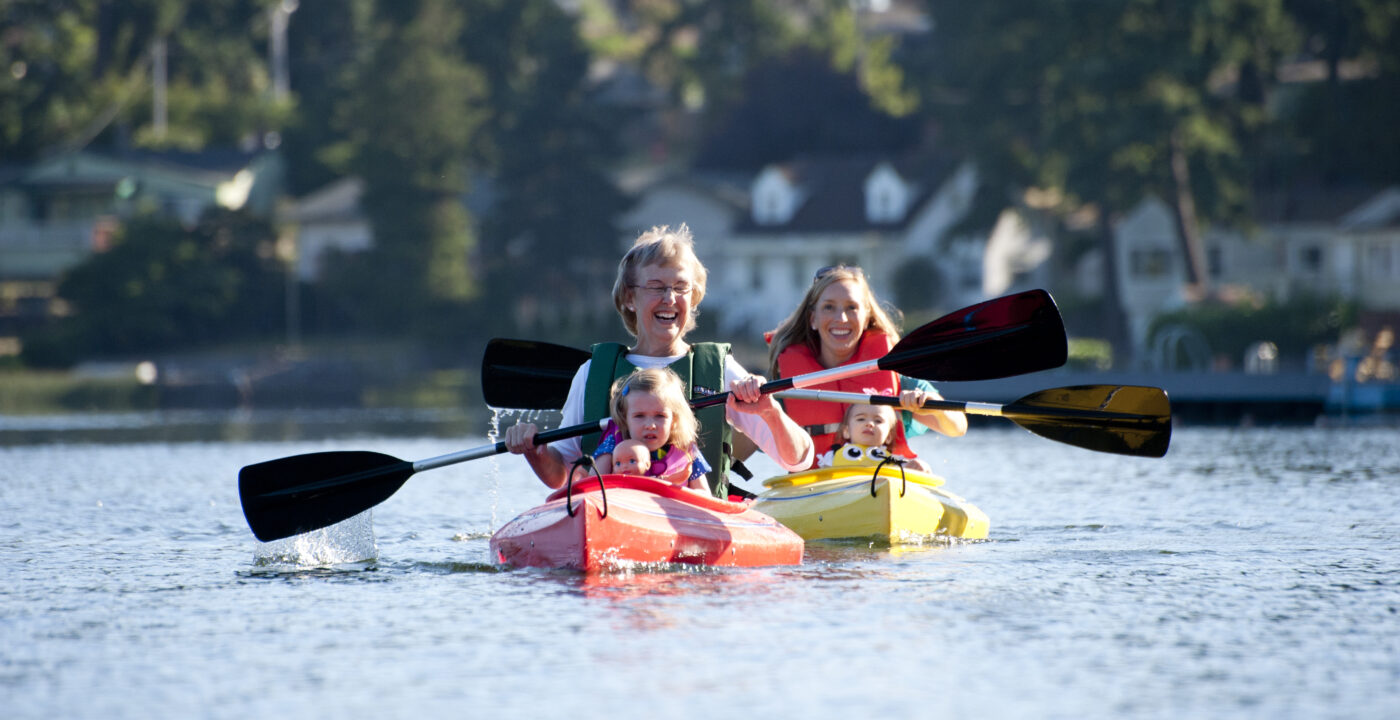
With so many lakes, rivers and waterfronts to explore across the Pacific Northwest, it’s no surprise that paddle sport popularity continues to grow. Before hitting the water, make sure you and your family are equipped for a safe outing.
According to Washington’s recreational boating accident data, 55 percent of all fatal recreational boating accidents in 2022 occurred on human-powered watercraft. Accidents can happen anywhere, to anyone and even in the most unexpected of conditions.
Follow these tips when kayaking, canoeing or stand-up paddleboarding.
Tips for paddlers
- Take a course to increase your knowledge of paddle sport safety, emergency procedures and navigational rules.
- Pick an activity level that’s suitable for your ability and gear.
- Always wear a life jacket.
- Carry a sounding device (horn, whistle or bell), a navigation light (lantern, flashlight) and visual distress signals such as flares.
- Be visible and wear brightly colored clothing, put reflective tape on paddles and use a flagpole.
- Don’t go out on the water while under the influence of drugs or alcohol.
- Check the weather and know that it can change rapidly.
- Dress for the water temperature, not the air temperature. Expect to get wet.
- Tell your family/friends your specific plan: where you will put in, your planned travel route, exit location and expected return time.
Tips for everyone
Sadly, the risk of drowning while on the water is even higher for children and teens: In Washington, drowning is a leading cause of fatal injury for children and teens ages 1 to 17 and number-one cause for ages 1 to 4.
Here are some general water safety tips for anyone planning to paddle, boat, swim or play in the water this summer.
1. Always wear life jackets when in/near open water.
Life jackets may feel like a chore to wear, but they could save your life. According to the U.S. Coast Guard, 75 percent of boating fatalities in 2023 involved drowning and 87 percent of drowning victims were not wearing a life jacket.
You may be thinking, “I know how to swim. Why do I need a life jacket?”
But being able to swim won’t necessarily help in chilly Washington waters, which average 50–55 degrees year-round. Water this cold can dangerously lower body temperature, making your limbs numb and swimming difficult.
“You can be an excellent swimmer, but if you can’t move your muscles, you’ll sink like a stone,” says Erin Summa, health promotion program manager for Mary Bridge Children’s Center for Childhood Safety.
Cold shock response, or the body’s automatic reflex when immersed in cold water, may trigger a deep inhalation of air. If you’re underwater when this happens, you may end up with water in your lungs, making the situation worse.
Life jackets keep you afloat and help your core stay warm.
Children should always wear a life jacket near open water, whether swimming or boating. Washington state law requires children 12 years and younger to wear a U.S. Coast Guard-approved life jacket at all times when underway in a vessel less than 19 feet in length.
When deciding whether kids should wear life jackets or inflatables in a swimming pool, there are a few things to consider.
While it’s a good idea to test the fit of their life jacket in a controlled setting like a pool, it’s best that kids not use flotation devices in pools routinely because it can lead them to assume their body floats. A pool is a great place to learn how their body naturally moves in water — with active adult supervision, of course.
Be sure to check the life jacket fit. Fasten all zippers and straps and pull them snug. To test whether it’s fitted properly, pull up on the shoulders. Your child’s ears and chin should not slip through the life jacket.
Water wings, rescue rings and boat cushions are not a replacement for life jackets, and life jackets shouldn’t be a substitute for a designated “water watcher” keeping an active eye on children in the water.
2. Enroll your children in swimming lessons.
Swimming doesn’t drown-proof a person, but it’s an important skill to have — and the only sport that could potentially save your life, Summa says.
Enroll your children in swimming lessons every summer to maintain and grow their skills, she suggests.
“It’s not a box you check — it’s ongoing education,” she adds.
The Y of Pierce and Kitsap Counties offers a variety of youth and adult swim lessons at multiple locations.
Metro Parks Tacoma offers swim lessons as well, plus outdoor and indoor pools open to the public.
3. Obtain a boater safety education card.
Did you know Washington state law requires operators of power-driven vessels with 15 horsepower or greater — basically all power boats and personal watercraft — to take a safety education course and obtain a Washington state boater education card?
Boaters age 12 and older can take the course in a classroom, online or at home. Learn more at the Washington State Recreation and Conservation Office’s boating safety and education website.
4. Remember water hazards exist at home, too.
Water is everywhere, from the toilet to buckets in the backyard. If your child goes missing at home, check sources of water first.
“Toddlers are curious by nature and top-heavy by design,” Summa says.
Never leave your baby or toddler in the tub, even for just a second. Baby bath seats often provide a false sense of security. They are not a safety device and do not prevent drowning.
If you have a pool at home, be sure to use multiple layers of protection: a four-sided fence, self-closing gate latches, door alarms and spa/pool covers. For aboveground pools, remove the ladder when not in use.
Summa also recommends toilet lid locks, since toilets are at perfect reach for a toddler.
More water safety tips from Mary Bridge Children’s Center for Childhood Safety